Circle Of Competence
How To Avoid Problems?
Stick To The Knitting!
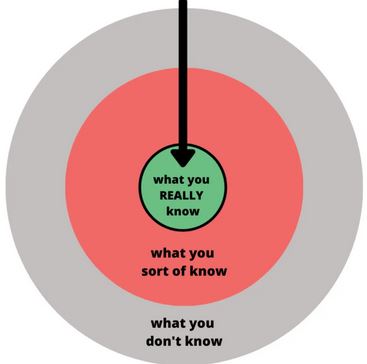
Circle Of Competence - Overview
A circle of competence is a clearly defined, narrow area of focus, about which you know a lot and which gives you a competitive edge.
The concept can, allegedly, be traced back to Andrew Carnegie and his single minded focus on steel and iron.
The phrase has come to prominence via Warren Buffet and his partner Charlie Munger in their 1996 shareholder letter.
Buffett and Munger initially developed the idea to limit where they would make financial investments (based on their own understanding and experience).
Buffet and Munger say that it "...is not the product of unique or otherworldly wisdom. Rather, it is merely the mundane result of diligent knowledge acquisition about a targeted subject. Any committed individual can build such a circle of competence, given the will to do so."
Another common and similar phrase with the same meaning is "stick to the
knitting" which was popularized by Tom Peters in his book "In Search of
Excellence".
Inside the circle lie your skills that you have mastered throughout your career, or life. And beyond the circle are the things you understand only partially, or not at all.
The circle of competence model can be very useful in all areas of life and it is very simple:
- Many people know a little about a lot. But someone with a circle of competence is someone who knows a lot about a clearly defined narrow area of focus.
- It is any area of life or business where through study and experience, you have built up a bank of useful and practical knowledge.
- This means that you know what works, what doesn't work and why.
- Understand where you’re naturally strong and stay within that area.
- And it’s not the size of the circle of competence that matters, but how well you stick within it.
3 Reasons Why You Should Stay Within Your Circle Of Competence
1. You possess an informational advantage over others.
In my current "day job" I am involved in the fuel business, in what is known as the secondary market, and my specialism is refined fuel and crude oil.
Within this field I have developed deep knowledge of this market. One of the features of this market is the number of fraudsters, scammers and general time-wasters.
Over the past 7 or 8 years I have developed a range of skills and techniques for conducting due diligence to identify these bad people. This is a very narrow field, but within it I have an informational advantage over most of the potential buyers/sellers I meet who do not have as much expertise.
Outside of this niche I have a lot of generalised business experience and expertise. But this market is one of my circles of competence.
2. It narrows down your options of what you get involved in.
I am regularly asked if I can source other commodities, but I always decline. I made the decision several years ago to stick exclusively to the fuel business, and I pass on all such requests, preferring to focus exclusively on this.
3. You make fewer mistakes.
I do still make mistakes, but generally I am able to anticipate and avoid most of the typical errors and mistakes that plague less experienced buyers in this market because I actually know what I am doing.
Return from "Circle Of Competence" to: Mental Models

LATEST ARTICLES


Adult Development Without Becoming Someone Else - Growth Without Identity Upgrade
 You do not grow by becoming someone else - you grow by placing authority where choice becomes possible. So much of what is written and taught about personal growth quietly assumes an identity upgrade…
Belief and Thought: What Zen Tools Works With - What It Leaves Alone
 A Clarification Of Scope Within Zen Tools - Not A Position On Belief As soon as people begin to notice their own thinking more clearly, questions about belief and thought naturally follow: - If though…
How Thought Becomes Identity - The Hidden Mechanism Behind Overthinking, Self-Worth, and Inner Conflict
 Thought Is an Event, Not a Self Most people believe identity is something they have - a stable sense of who they are. In reality, identity is something the mind is continuously producing. It is not fo…
When the Brain Is Hijacked - Where Does Choice Sit?"
 Pressure, the Hijacked Brain, and the Question of Authority
When the brain is hijacked, people are often told they have “lost control”.That language is understandable - and misleading. In reality, man…
Pressure, the Hijacked Brain, and the Question of Authority
When the brain is hijacked, people are often told they have “lost control”.That language is understandable - and misleading. In reality, man…Reduce Digital Overthinking To Lower Your Constant Inner Noise
 Why Constant Micro-Stimulation Increases Your Internal Noise. Modern digital life generates a level of mental activity that previous generations never had to deal with, and this is fundamentally why w…
Pausing Before You Act - Make It a Meta-Habit
 How A Tiny Moment Unlocks Clarity, Choice, And Self-Leadership. There is a moment in life so subtle you barely register it. A colleague questions your idea. A notification flashes. A moment of uncerta…
How to Interrupt Emotional Spirals Using Thought-Awareness
 The spiral is fueled by your mind believing the story your thoughts tell. No one sets out to be swept away by a surge of emotion. One second you’re handling life, and the next, your mind has broken in…
Universal Awareness and the Machinery of Thought
 You Can’t Control Thoughts - But You Can Learn To See Them. Why do our thoughts have so much power over us - and how do we reclaim clarity? The foundation of thought-awareness is the ability to see yo…
Rewiring Your Autopilot – How To Harness Your Subconscious Mind
 How to harness your subconscious mind and move from passenger to pilot. The case for rewiring your autopilot is that most of what drives your thoughts, reactions, and decisions happens below your cons…
Why You Need To Be Intimate With Your Own Thinking
 How self-awareness and insight transforms delusion into wisdom. We live inside an invisible weather system - one made not of clouds and wind, but of thoughts - and this invisibilty is why you need to…
The Illusion of Closeness in Always-On Relationships
 Closeness that cannot survive absence was never intimacy - only constant stimulation mistaken for connection. We live inside an unprecedented experiment in human connection. For the first time in hist…
Why Approval Feels Like Safety And Distance Feels Like Danger
 Safety is not found in being approved - it appears when approval is no longer required. When approval feels like safety, connection stops being something we enjoy and quietly becomes something we rely…