Myers Briggs ISFJ
The Protector
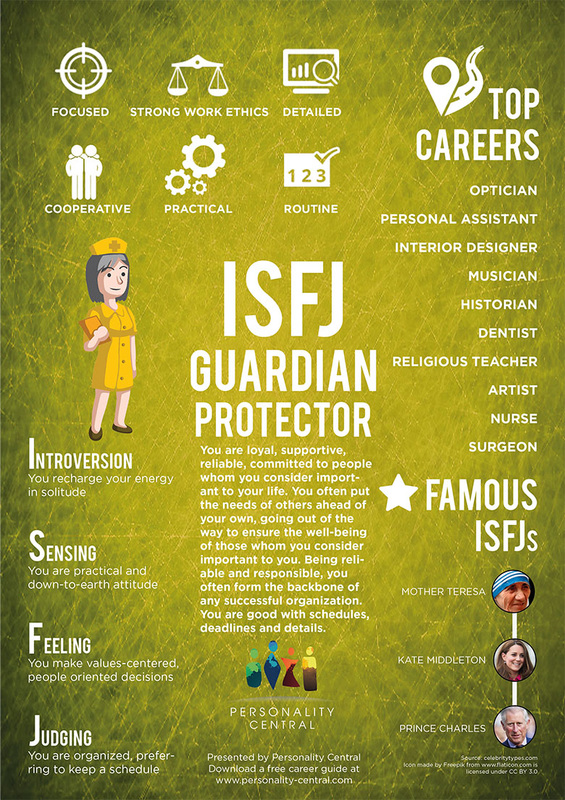
Myers Briggs ISFJ - Summary
- Quiet friendly, responsible and conscientious.
- Committed and steady in meeting their obligations.
- Thorough, painstaking and accurate.
- Loyal, considerate, notice and remember details about people who are important to them, concerned with how others feel.
- Strive to create an orderly and harmonious environment at work and at home.
Myers Briggs ISFJ - Characteristics
- Myers Briggs ISFJ are interested in maintaining order and harmony in every aspect of their lives. They are steadfast and meticulous in handling their responsibilities. Although quiet, they are people-oriented and very observant. Not only do they remember details about others, but they also observe and respect others’ feelings. Friends and family are likely to describe them as thoughtful and trustworthy.
- They are most concerned with taking care of people by keeping them safe and secure. They are modest caretakers who do not demand credit or thanks for their efforts. But while they are essentially compassionate, and in fact exercise more patience in dealing with the disabled than perhaps any other type, their shyness with strangers can lead others to misread them as standoffish.
- Only among friends and family may this quiet type feel comfortable speaking freely. They are serious people with a strong work ethic, not inclined to self-indulgence. They believe in being meticulous and thrifty. They work well alone. While they may enjoy taking care of others, they do not enjoy giving orders.
- They collect data in the present moment and compare it with past experiences, a process that sometimes evokes the feelings associated with memory, as if the subject were reliving it. Seeking to protect what is familiar, they draw upon history to form goals and expectations about what will happen in the future.
- ISFJ seek social connections and creates harmonious interactions through polite, considerate, and appropriate behaviour. They respond to the explicit (and implicit) wants of others, and may even create an internal conflict between the subject’s own needs and the desire to meet the needs of others.
- They seek precision, such as the exact word to express an idea. This type notices the minute distinctions that define the essence of things, then analyses and classifies them. This type examine all sides of an issue, looking to solve problems while minimising effort and risk. They use models to root out logical inconsistency.
- ISFJ finds and interprets hidden meanings, using “what if” questions to explore alternatives, allowing multiple possibilities to coexist. This imaginative play weaves together insights and experiences from various sources to form a new whole, which can then become a catalyst to action.
Take the Myers Briggs Test [Note: This currently costs $49.99]
Return to main page: Myers Briggs Type Indicators

LATEST ARTICLES


Why Approval Feels Like Safety And Distance Feels Like Danger
 Safety is not found in being approved - it appears when approval is no longer required. When approval feels like safety, connection stops being something we enjoy and quietly becomes something we rely…
You Do Not Need Better Boundaries - You Need Clearer Thought
 What no longer feels like your responsibility no longer crosses your boundaries. This article explains why you don’t need better boundaries - you need clearer thought - how modern life systematically…
When Relationships Become Identity - Self-Worth is Based On Connection
 Much of our relationship suffering comes from a subtle cognitive shift in which relationships become fused with identity. When relationships become identity, connection is no longer simply experienced…
How Digital Communication Fuels Relationship Anxiety
 Micro-Signals, Macro-Meaning. Modern relationships based on digital communication do not usually break down because of betrayal, cruelty, or lack of care. They fracture under the weight of interpretat…
Why Absence Feels Like Rejection - Thought Patterns in Relationships
 The mind doesn’t just experience absence. It interprets absence. You send a message. It’s casual. Nothing heavy. Maybe a question, maybe a light comment. Normally you’d get a reply within an hour or t…
Why Insight Alone Does Not Change Behaviour - Locking In The Gains
 Insight Changes Understanding, But Not Jurisdiction. This article explores why insight alone does not change behaviour, not by dismissing thought awareness, but by showing what must come after it if c…
The Mechanics Of Inner Conflict - Not Confusing Signals As Instructions
 No Internal Signal Requires Immediate Obedience. Most people experience inner conflict as something emotional: tension, anxiety, guilt, hesitation, self‑doubt. It feels personal and psychological. Som…
Master The Season You Are In - The Key to Fulfilling Your Purpose
 To fulfil your purpose, you must first master the season you are in. One of the biggest mistakes you can make in life is focusing all your energy on the next season instead of learning to master the s…
The Inner Weight of Shame - Sustained By Attentional Fixation
 A Mind That Is Continuously Engaged In Self-Surveillance. Shame is one of the heaviest inner burdens a human being can carry. It does not announce itself loudly or demand attention through drama. Inst…
Does Prayer Work? The Psychology of Prayer, Meditation and Outcomes
 Reality Is A Complex System Of Countless Interactions - Including Yours. So does prayer work? The problem is that the question itself is usually framed in a way that guarantees confusion. We tend to a…
Living in Survival Mode Without Surrendering Mental Authority
Living in Survival Mode Without Surrendering Mental Authority
 Clear Thinking When You’re Just Trying to Stay Afloat. Many people today are overwhelmed because they are living in survival mode - not temporarily, but as a persistent condition of life. For many, th…