Occams Razor
The Best Explanation Has The Fewest Assumptions
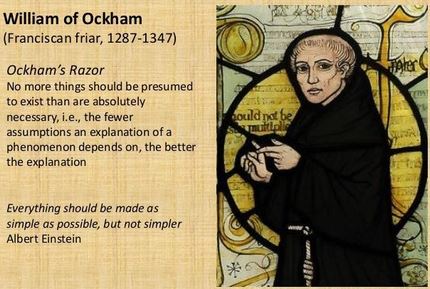
What is Occams Razor?
Occams razor is credited to William of Ockham, a 14th-century Franciscan friar, theologian and philosopher.
In philosophical debate a razor is an abductive rule of thumb or heuristic that infers that unlikely predictions, or explanations, are to be "shaved off" on balance of probability.
It is also referred to as a law of parsimony which is a principle that says that: ‘Entities should not be multiplied without necessity.’ (In Latin, Entia non sunt multiplicanda praeter necessitatem.)
However, it seems that William of Ockham never actually said this in any of his writings!
In plain modern english, Occams razor, or the law of parsimony, means that:
The best explanation is the one that requires you to make the fewest possible assumptions about what's involved.
- It is important to note that the razor is only applied to competing hypothesis about the same prediction.
- Occams razor will select the solution with the fewest assumptions.
- Simpler hypotheses are preferable to more complex ones because they are more testable.
- Occams razor is not meant to be a way of selecting hypotheses that make different predictions.
- It can not be used as to establish an irrefutable principle of logic,
- It can not be used to confirm the truth of a situation.
- It is definitely not to be considered as a scientific proof.
- It does not prescribe oversimplification, if a more complex theory is available that better explains the
facts, then the more complex theory should be preferred.
- It is a mental model to be used as a part of a toolbox or portfolio of thinking skills for making initial conclusions before the full scope of information can be obtained.
Exceptions To Occams Razor
There are exceptions to every rule:
- Simplicity alone is not enough. A conclusion must be backed by empirical evidence.
- Blind faith is not enough, no mental model shoudl be relied on when it is contradicted by logic, experience, or empirical evidence.
- We must be aware of falling prey to cognitive biases.
- Because the world is far more complicated than any of us can conceive, thus sometimes the simplest model just isn’t the correct one.
Praise For Occams Razor
Albert Einstein
“It can scarcely be denied that the supreme goal of all theory is to make the irreducible basic elements as simple and as few as possible without having to surrender the adequate representation of a single datum of experience.”
“Everything should be made as simple as
possible, but not simpler.”
Stephen Hawking
"We could still imagine that there is a set of laws that determines events completely for some supernatural being, who could observe the present state of the universe without disturbing it. However, such models of the universe are not of much interest to us mortals. It seems better to employ the principle known as Occam’s razor and cut out all the features of the theory that cannot be observed."
Isaac Newton
"We are to admit no more causes of natural things than such as are both true and sufficient to explain their appearances.”
Applying Occams Razor
Return to: How To Think

LATEST ARTICLES


Why Approval Feels Like Safety And Distance Feels Like Danger
 Safety is not found in being approved - it appears when approval is no longer required. When approval feels like safety, connection stops being something we enjoy and quietly becomes something we rely…
You Do Not Need Better Boundaries - You Need Clearer Thought
 What no longer feels like your responsibility no longer crosses your boundaries. This article explains why you don’t need better boundaries - you need clearer thought - how modern life systematically…
When Relationships Become Identity - Self-Worth is Based On Connection
 Much of our relationship suffering comes from a subtle cognitive shift in which relationships become fused with identity. When relationships become identity, connection is no longer simply experienced…
How Digital Communication Fuels Relationship Anxiety
 Micro-Signals, Macro-Meaning. Modern relationships based on digital communication do not usually break down because of betrayal, cruelty, or lack of care. They fracture under the weight of interpretat…
Why Absence Feels Like Rejection - Thought Patterns in Relationships
 The mind doesn’t just experience absence. It interprets absence. You send a message. It’s casual. Nothing heavy. Maybe a question, maybe a light comment. Normally you’d get a reply within an hour or t…
Why Insight Alone Does Not Change Behaviour - Locking In The Gains
 Insight Changes Understanding, But Not Jurisdiction. This article explores why insight alone does not change behaviour, not by dismissing thought awareness, but by showing what must come after it if c…
The Mechanics Of Inner Conflict - Not Confusing Signals As Instructions
 No Internal Signal Requires Immediate Obedience. Most people experience inner conflict as something emotional: tension, anxiety, guilt, hesitation, self‑doubt. It feels personal and psychological. Som…
Master The Season You Are In - The Key to Fulfilling Your Purpose
 To fulfil your purpose, you must first master the season you are in. One of the biggest mistakes you can make in life is focusing all your energy on the next season instead of learning to master the s…
The Inner Weight of Shame - Sustained By Attentional Fixation
 A Mind That Is Continuously Engaged In Self-Surveillance. Shame is one of the heaviest inner burdens a human being can carry. It does not announce itself loudly or demand attention through drama. Inst…
Does Prayer Work? The Psychology of Prayer, Meditation and Outcomes
 Reality Is A Complex System Of Countless Interactions - Including Yours. So does prayer work? The problem is that the question itself is usually framed in a way that guarantees confusion. We tend to a…
Living in Survival Mode Without Surrendering Mental Authority
Living in Survival Mode Without Surrendering Mental Authority
 Clear Thinking When You’re Just Trying to Stay Afloat. Many people today are overwhelmed because they are living in survival mode - not temporarily, but as a persistent condition of life. For many, th…